
Slipped Disc Without Surgery Can Physiotherapy Actually Fix It?

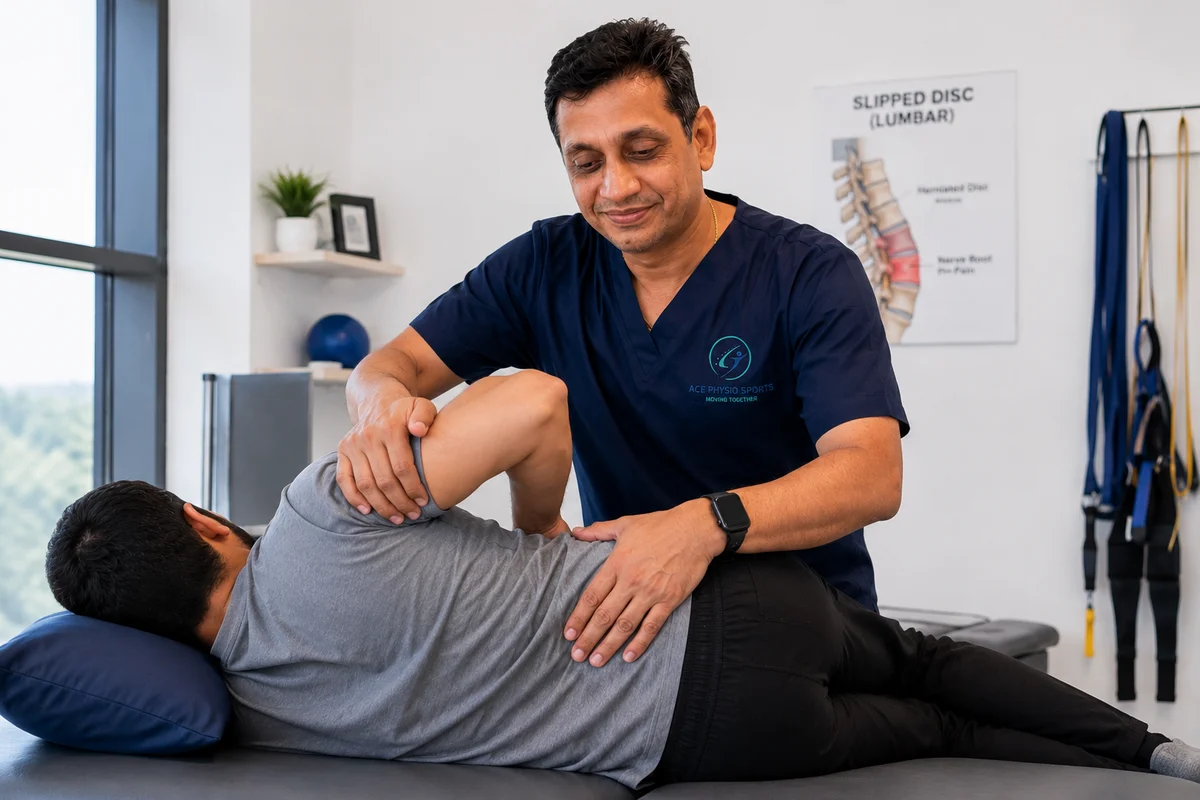
You've Been Told You Need Surgery for Your Slipped Disc. Here's Why That's Probably Not True.
I've been a physiotherapist in Singapore for over 20 years. In that time I've treated hundreds of patients with slipped discs at major hospitals including Tan Tock Sen Hospital, Alexandra Hospital, and Mount Elizabeth, and now at our clinic on East Coast Road in Singapore.
In all those years, I'd estimate that fewer than one in ten slipped disc patients I've seen actually needed surgery.
Most came to me convinced they were heading for the operating table. Some had already been booked in. A significant number of them are now pain-free back at the gym, playing with their children, sitting through full workdays without discomfort. No surgery. No long-term medication. Just a proper understanding of what a slipped disc actually is, and a structured treatment plan built around fixing the cause rather than suppressing the symptom.
This post is for anyone who has recently been told they have a slipped disc whether that diagnosis came from an MRI, a GP referral, an orthopaedic specialist, or a concerned family member who Googled your symptoms. Whether you are based near our clinic in Katong, Marine Parade, Bedok, or Siglap, or you are reading this from overseas and exploring your options before travelling to Singapore for treatment I want to give you an honest, clinically accurate picture of what is happening in your back, what your real options are, and what recovery actually looks like.
What a Slipped Disc Actually Is And What It Isn't
The term "slipped disc" is one of the most misleading phrases in musculoskeletal medicine. Discs do not slip. They cannot they are firmly attached to the vertebrae above and below them by strong fibrous rings.
What actually happens is this. Each disc in your spine has two parts a tough outer ring called the annulus fibrosus, and a gel-like centre called the nucleus pulposus. When the outer ring develops a tear usually from years of repetitive stress, sustained poor posture, or a sudden load applied to a vulnerable position the gel centre can push outward. This is called a herniation or prolapse. In common language, a slipped disc.
The pain in most cases is not caused by the herniation itself — it is caused by what the herniated disc pushes against. If it presses toward the spinal canal and contacts a nerve root, you get radiating pain down the leg (sciatica), tingling, numbness, or in more serious cases, weakness in the foot or lower leg.
Here is the critical clinical point that changes everything for patients: the degree of herniation visible on an MRI does not reliably predict the amount of pain or disability a person experiences. I have treated patients at our East Coast Road clinic with large herniations on imaging who had mild symptoms. I have also treated patients with relatively minor herniations who could barely walk. The scan tells you what is anatomically present. It does not tell you how your nervous system is responding to it or how it will respond to the right treatment.
Why Surgery Is Recommended More Often Than Necessary
I want to be clear before going further I am not anti-surgery. There are genuine clinical situations where surgical intervention is the right and necessary choice, and I will address those explicitly later in this post.
But those situations represent a minority of slipped disc presentations in clinical practice.
The research on this is consistent and has been for over two decades. Multiple large-scale studies including the landmark SPORT trial published in the Journal of the American Medical Association found that outcomes for most lumbar disc herniation patients are equivalent between surgical and non-surgical treatment when measured at one and two years post-treatment. The surgical group tends to improve faster in the first three to six months. The conservative physiotherapy group catches up. Long-term outcomes are comparable.
What this means practically is that for the majority of slipped disc patients, physiotherapy-led rehabilitation is not a compromise, a delay, or a consolation prize. It is a clinically appropriate primary treatment supported by the best available evidence.
What Physiotherapy for a Slipped Disc Actually Involves
This is where I want to be specific, because "physiotherapy" is not a single thing. The quality and type of treatment varies enormously between providers. A generic exercise sheet from a hospital outpatient waiting room is not the same as structured, supervised, clinician-led rehabilitation.
At Ace Physio Sports, located at East Gate Building on East Coast Road in Singapore, treatment for a slipped disc follows a structured three-phase approach that I have refined over twenty years of clinical practice.
Phase 1 — Pain Management and Nerve Calming (Weeks 1 to 3)
The first priority is reducing the acute inflammatory response around the disc and calming the sensitised nerve root. This involves specific manual therapy to the lumbar spine not aggressive manipulation, which is contraindicated in acute disc herniation, but carefully graded mobilisation of the segments above and below the affected level to reduce protective muscle spasm and restore segmental movement.
We also use nerve mobilisation techniques precisely controlled movements that gently mobilise the sciatic nerve through its course to prevent neural adhesion and reduce peripheral sensitisation. Most patients notice a meaningful reduction in leg pain and tingling within two to three sessions of this targeted work.
For patients with significant protective muscle spasm which is extremely common in acute disc herniations dry needling to the deep lumbar paraspinals and gluteal muscles can accelerate progress noticeably. It is not appropriate for every patient, but where guarding is severe it is a useful adjunct.
The majority of patients I treat at our East Coast Road clinic report a 40 to 60 percent reduction in pain intensity by the end of Phase 1. That does not mean the disc has healed it means the nervous system has calmed sufficiently to begin the real rehabilitation work.
Phase 2 — Movement Restoration and Root Cause Correction (Weeks 3 to 8)
Once acute pain is managed, the focus shifts to understanding and correcting why the disc herniated in the first place. In my clinical experience, the majority of lumbar disc herniations presenting at our Singapore clinic are the result of years of sustained lumbar flexion loading essentially, sitting in a rounded lower back position for eight to ten hours daily, combined with insufficient deep core stability and tight hip flexors that have adaptively shortened from prolonged sitting.
This phase involves detailed movement re-education. We address lumbar flexion bias, teach proper hip hinge mechanics, retrain the deep spinal stabilising system specifically the multifidus and transverse abdominis, both of which are reliably inhibited by pain and disuse and begin progressive loading of the lumbar spine in positions it can tolerate and build from.
Clinical Pilates methodology is extremely useful at this stage. Not the group class version, but the clinical application where every exercise is individually selected and progressed based on your specific movement deficits, pain behaviour, and neurological status. This is something we do routinely at Ace Physio Sports and it forms a core part of our disc rehabilitation programme.
Phase 3 — Load Building and Return to Full Activity (Weeks 8 to 16)
This is the phase where many clinics stop prematurely and where many patients relapse. Pain has resolved, the patient feels functional, they are discharged. Six months later they are back with the same problem, sometimes worse.
The disc that herniated is structurally different from how it was before. The surrounding musculature that failed to protect it is not automatically strong again just because pain has resolved. Phase 3 is about building genuine, lasting resilience progressive loading of the lumbar spine through its full functional range, sport-specific or work-specific rehabilitation, and developing the patient's own capacity to manage their spine independently long term.
I tell every slipped disc patient the same thing at the end of Phase 3: your back will be as strong as it was before this happened, possibly stronger, if you do the work here. The patients who commit to this phase are the ones who do not come back with the same injury.
How Long Does Recovery Take?
The honest answer it depends significantly on how long you have had symptoms and how the herniation has presented neurologically.
Acute herniations treated promptly within the first six to eight weeks of onset typically resolve well within three to four months of structured physiotherapy. Patients who have had symptoms for over a year before seeking proper treatment take longer sometimes six months or more for full functional resolution.
This is not because chronic disc herniations are untreatable. It is because chronic nerve sensitisation, adaptive muscle inhibition, and movement compensation patterns that have been in place for months take more time and more sophisticated treatment to reverse.
This is the single most important reason not to delay. If you are in Singapore whether in our local area of East Coast, Katong, Bedok, or Siglap, or anywhere else on the island and you have been managing a slipped disc with painkillers and hoping it resolves on its own for more than three months, please get a proper clinical assessment. The window for easiest recovery narrows the longer you wait.
The same applies to patients travelling to Singapore from the region Indonesia, Malaysia, India, the Philippines who contact us specifically for intensive physiotherapy treatment. We do accommodate short-stay intensive programmes for international patients. Speak to us directly about what is feasible for your timeline.
When Surgery Is Actually the Right Choice
I want to address this with full honesty because too much physiotherapy-centric content online either downplays or ignores it.
If you have progressive neurological deficit specifically, weakness in your leg or foot that is measurably worsening week by week surgical consultation should happen promptly. Waiting in this scenario risks permanent nerve damage that even excellent surgery cannot fully reverse.
If you have cauda equina syndrome loss of sensation in the saddle area, difficulty initiating or controlling urination, loss of bowel control this is a neurosurgical emergency. Go to A&E immediately. Do not call a physiotherapist. Do not wait until morning.
If you have had a genuine, consistent trial of high-quality physiotherapy for twelve to sixteen weeks with no meaningful improvement in symptoms or function, surgical consultation is entirely appropriate and I would actively encourage it. Good physiotherapy and good surgical opinion work together, not against each other.
At Ace Physio Sports we work alongside orthopaedic surgeons and spine specialists at hospitals across Singapore. We can refer directly where clinically appropriate and provide detailed physiotherapy assessment reports for specialists who want a conservative treatment history before advising on surgery.
What to Do Next
If you are in Singapore and have been diagnosed with a slipped disc, book an assessment at Ace Physio Sports before making any decisions about surgery.
We are located at East Gate Building, 46 East Coast Road, #08-03, Singapore 428766 easily accessible from Katong, Marine Parade, Bedok, Siglap, Tanjong Rhu, and Mountbatten, with parking available on East Coast Road.
Bring your MRI report and images if you have them. Wear comfortable clothing. The first session takes approximately 50 minutes and you will leave with a clear clinical understanding of your specific disc herniation, whether physiotherapy is the right primary treatment for your presentation, and a realistic, honest recovery timeline.
No referral needed. Book directly at acephysiosport.com or call +65 81535374.
Ready to Take the Next Step?
If you have been diagnosed with a slipped disc and you are based in Singapore whether near our clinic in East Coast, Katong, Marine Parade, Bedok, or Siglap, or anywhere else on the island our team is here to help you understand your options clearly before you commit to anything.
Our dedicated slipped disc treatment page covers exactly what to expect at your first appointment, the specific techniques we use, and what a realistic recovery looks like for your type of disc herniation.
Learn About Our Slipped Disc Physiotherapy Treatment in Singapore →